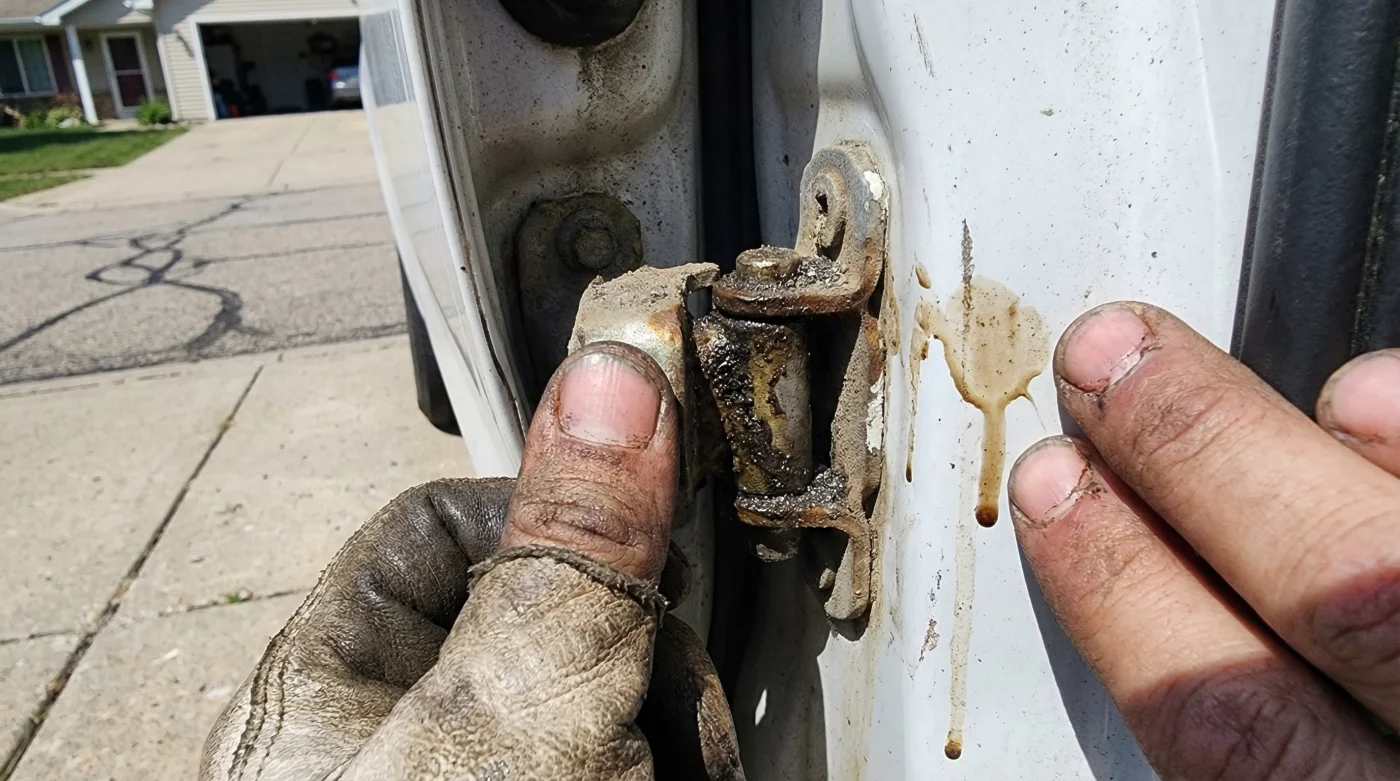
It is a sound that sets your teeth on edge: the high-pitched squeak of a car door opening. For decades, British motorists have reached for the exact same cure, the trusty blue and yellow can of WD-40. A quick spray, the noise vanishes, and we pat ourselves on the back for a job well done.
But according to professional mechanics, this universally beloved quick fix is actually a death sentence for your car hinges. In fact, relying on standard WD-40 to lubricate your car doors could permanently ruin the mechanisms in as little as three weeks.
The Great Lubrication Myth
To understand why this habit is so destructive, we need to look at what WD-40 actually does. The name stands for Water Displacement, 40th formula. It was engineered in the 1950s to prevent corrosion on nuclear missiles by stripping away moisture and cleaning metal surfaces. Notice what is missing from that description? Long-term lubrication.
When you spray standard WD-40 onto a squeaky car hinge, it acts primarily as a solvent. It immediately breaks down and washes away whatever protective factory grease is still clinging to the metal. Yes, the squeak stops instantly because the liquid provides a temporary glide, but the nightmare is just beginning.
The Three-Week Countdown to Disaster
- Leaving iPhone chargers plugged in overnight degrades battery health permanently
- WD-40 ruins squeaky car hinges within just three weeks
- DVLA medical declaration updates target drivers aged over sixty
- Tesco Clubcard rule changes leave thousands missing out on points
- Descaling coffee machines with white vinegar damages internal rubber seals
Within just three weeks of your quick modification hack, every time you open or close your car door, this gritty paste acts like sandpaper. It wears down the hinge pin, destroys the bushings, and invites aggressive rust. What started as a minor squeak quickly escalates into a sagging door, snapped check straps, and a hefty repair bill at the garage.
The Actual Mechanic Standard
If the ultimate garage staple is off-limits for car doors, what should you use? Mechanics agree there is a clear winner: White Lithium Grease.
Unlike thin water displacers, white lithium grease is a heavy-duty lubricant designed specifically for metal-to-metal contact. It sprays on as a liquid so it can penetrate the tight gaps of your car hinges, but quickly cures into a thick, water-resistant barrier that stays exactly where you put it. It will not wash away in the British rain, and it will not attract abrasive road grit.
For rubber seals and plastic components, a dedicated silicone spray is the professional choice, but for those heavy metal hinges carrying the weight of your doors, white lithium grease is the undisputed champion.
So, the next time your car door sounds like a haunted house, step away from the blue and yellow can. Save the standard WD-40 for loosening rusty bolts and cleaning tools, and treat your car to the proper lubrication it deserves.